
Table of Contents
As data volumes continue to increase, many organisations find themselves balancing two competing priorities: controlling storage costs while maintaining performance. Data tiering offers a practical way to achieve both, allowing businesses to move data between different storage tiers based on usage patterns while keeping it accessible when needed. In this guide, we explore what data tiering is, how it works and the key considerations for implementing an effective tiering strategy.
Organisations have more data than ever before, but not all of it needs to sit on expensive, high-performance storage.
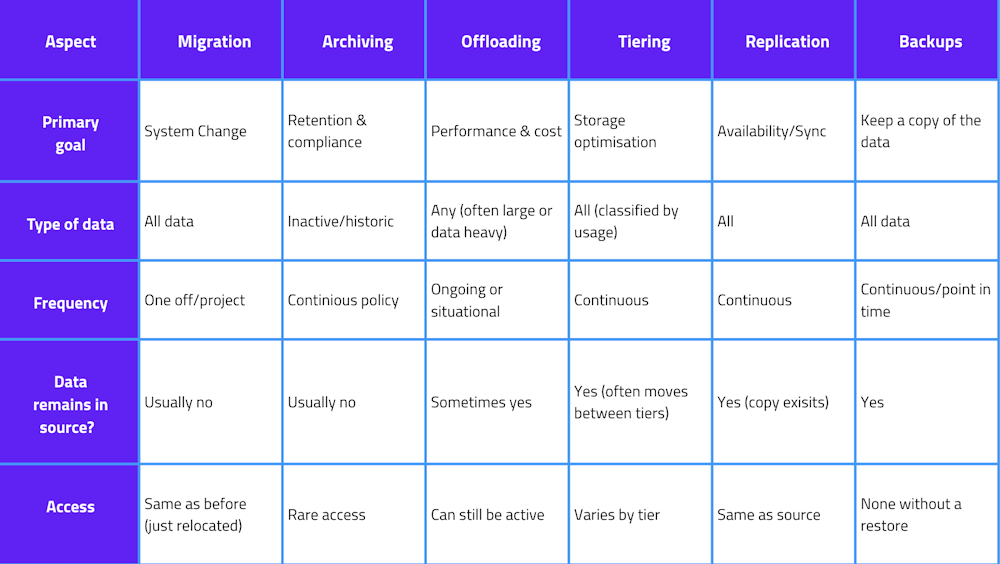
When people talk about moving data, they often use several different terms interchangeably. Data migration, archiving, offloading, replication and backups all involve moving or copying data in some way, but they each serve a different purpose. Understanding the distinction is important, as choosing the wrong approach can add unnecessary cost and complexity.
For example, if you’re replacing an application or platform, you’re likely looking at a migration project. If your focus is retaining historical records for compliance reasons, archiving may be the better fit. If you’re trying to improve database performance, offloading data could help. Data tiering, however, is specifically designed to reduce storage costs while keeping data available when it’s needed.
In this article, we’ll look at data tiering in more detail and explore when it might be the right approach for your organisation.
What is Data Tiering and Storage Tiers?
Data tiering is the practice of storing data on different levels of storage depending on how frequently it is accessed and how quickly it needs to be available.
The principle is simple. In a tiered storage model, frequently accessed data stays on primary storage or other high-performance systems, while infrequently accessed data is moved across different storage tiers according to need. Importantly, the data remains available to users and applications, often without any noticeable change to how it’s accessed. Many organisations use different classifications or names for storage tiers based on their own requirements.
The goal is to strike the right balance between performance and cost. Rather than paying premium prices to store all data on your fastest infrastructure, you reserve those resources for the information that genuinely needs them.
In many environments, over 70% of data is classified as cold data, which is why tiered data storage remains so relevant.
How is Data Tiering Different from Archiving?
One of the most common misconceptions is that tiering and archiving are the same thing. While both involve moving data, the objectives are quite different.
Data archiving focuses on preserving historical or inactive information, often for compliance, legal or governance purposes. In practice, archiving data means moving inactive data or archival data out of day-to-day operational use. Archived data may be removed from day-to-day operational systems and can require a separate retrieval process, with recovery times sometimes taking longer depending on the storage service used.
Data tiering, on the other hand, is about placing data on the most appropriate storage layer while keeping it available for ongoing use and supporting ongoing data access. The data may move between different classes of storage over time, but it remains part of the active data estate.
A useful way to think about it is that archiving helps you keep data, while tiering helps you store it more efficiently.
Why Consider Data Tiering for Cold Data?
For most organisations, cost is the biggest driver.
As data volumes continue to grow, so does the cost of storing it. Managing that increase alongside enterprise data growth and rising storage capacity demands makes keeping years of infrequently accessed information on premium storage hard to justify, particularly when lower-cost alternatives are available.
Storage capacity is growing 19.2% annually, reaching 180 zettabytes by 2025, which underlines why storage optimisation matters.
Tiering allows organisations to improve storage efficiency by aligning storage costs with actual usage. Recent transactional data, operational databases and critical data can remain on high-performance storage, while accessed data with lower access frequency is moved to cheaper tiers that are still accessible when required.
The result is a more efficient storage environment without compromising the availability of important business data. When applied well, data tiering can also deliver cost savings and in some cases cut storage costs by over 70%.
Understanding Your Data Classification
Before implementing a tiering strategy, it’s important to understand not just how your data is used, but how classification and data management fit into a broader data management strategy.
Some information may be accessed hundreds of times each day, while other datasets, including analytics data, are only reviewed periodically for reporting, audit or compliance purposes rather than needing the fastest tier. Understanding these usage patterns, along with access patterns and access frequency, helps determine which storage tier is most appropriate.
Storage providers often refer to this as hot, warm and, as mentioned before, cold data. Hot data is accessed regularly and requires fast performance. Warm data is still valuable but is used less frequently. Cold data may only be required occasionally yet still needs to be retained and remain accessible.
The challenge is identifying where each dataset sits today and recognising that its value and usage may change over time. As volumes grow, automated data classification can improve data management efficiency.
Key Considerations and Cost Efficiency Before Implementing Tiering
Successful data tiering starts with good governance across storage systems and storage infrastructure rather than technology alone.
Organisations should establish clear rules around when data moves between tiers, with placement kept data based, and with storage layers based, on business criticality, access frequency, sensitivity, retention and regulatory compliance. Automated storage tiering is a policy-driven approach to data movement between storage tiers based on monitored access patterns. Without defined policies, data can easily end up in the wrong place, either driving up storage costs unnecessarily or impacting performance.
It’s also important to understand how applications interact with tiered data. Some systems assume data is immediately available and may not perform as expected if information is stored on slower tiers. Testing is therefore essential before introducing any significant changes. That is particularly true with file tiering, where native access needs to be preserved when data is moved to object storage or cloud storage.
Data protection, data security and regulatory compliance requirements should also remain consistent regardless of where data is stored, with controls applied consistently across cloud environments as well as on-premisetiers. Moving information to a lower-cost storage tier should never result in weaker access controls, reduced encryption standards or non-compliance with regulatory obligations.
Finally, organisations should remember that tiering is not a one-off exercise. Data volumes, application usage and business requirements all evolve over time, meaning regular monitoring and review are essential if the strategy is to continue delivering value. Automated tiering can reduce IT data management workload significantly, but it still requires regular review.
A Practical Example
A business might decide that the most recent 12 months of transactional data should remain on primary storage because it supports daily operations and reporting for business-critical data, with the most latency-sensitive workloads treated as Tier 0 storage. In practice, a hot tier would then be reserved for active mission-critical data that needs ultra-fast access and high IOPS.
Data that is between one and three years old could be moved to a lower-cost storage tier as historical data, where it remains available but is unlikely to place significant demands on system performance. Information older than three years may then be moved to a cold storage tier, allowing it to be retained for historical reporting, audit purposes or compliance requirements at a significantly lower cost.
Some organisations use cloud tiering solutions to move cold or historical data into cloud data tiers while retaining access.
For some estates, file tiering can maximise savings and reduce vendor lock-in, and certain approaches can avoid egress-fee issues when data is accessed.
By aligning storage with actual usage, the organisation can reduce infrastructure costs without losing access to important information.
Summary
Traditional data tiering and newer approaches both work by matching data storage to the right storage media and storage tiers according to how information is used. In the traditional model, frequently accessed or business-critical data stays on fast on-premises platforms such as NAS, while colder data can move to lower-cost options such as object storage, cloud storage or archival tiers. When implemented effectively, this helps organisations optimise storage performance, protect overall storage performance and control costs while keeping business-critical information available.
Put simply, if your objective is to reduce storage costs while keeping data accessible, data tiering is likely to be the right approach. If your primary goal is long-term retention or compliance, archiving may be a better fit.
In the right environment, tiering cold data can reduce storage and backup costs significantly, while preserving access to unstructured data and other business information. If you’re considering a data tiering strategy and want to understand the potential benefits for your environment, WellData’s consultants can help you assess your existing data landscape and identify the most effective approach.
<< Back to Knowledge Centre