Table of Contents
Data replication can help organisations improve availability, support reporting and keep databases synchronised across different locations. In this guide, we explore how it works, the different approaches available and the key considerations before implementation.
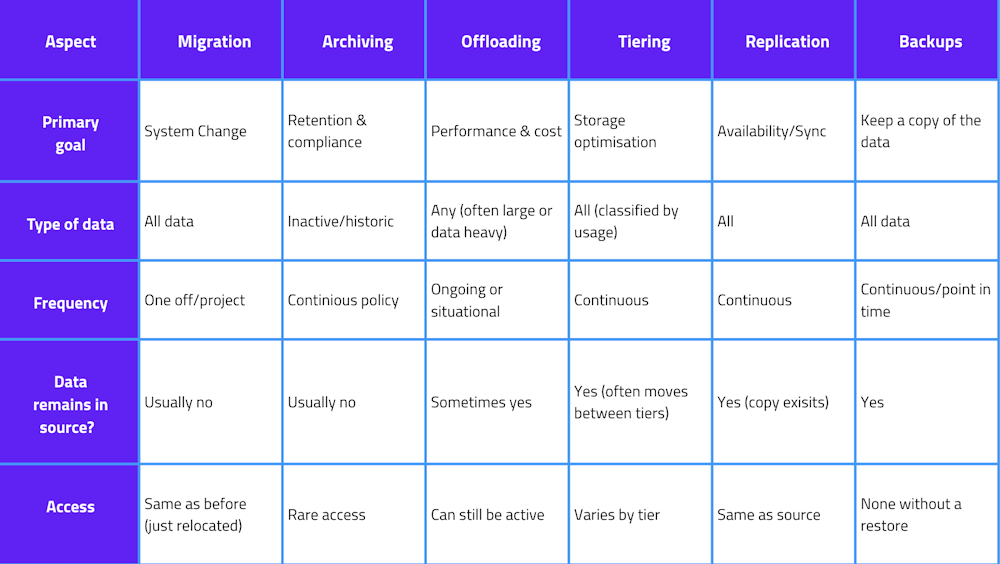
Moving data can serve several purposes, from replacing an application to retaining historical records or reducing storage costs. Choosing the right approach starts with understanding what you want to achieve.
As part of our data movement series, this article focuses on replication: when it is useful, how different methods operate and what is involved in managing it effectively.
What is data replication?
Data replication is the process of copying some or all the data from one database into a secondary database on a different server.
The scope can vary from an entire database to specific tables, rows or columns, depending on what the receiving system needs.
Why replicate data?
Replication can make data available on a secondary server if the primary server experiences an outage. It can also support reporting and analytics, allowing these workloads to run against a separate database rather than directly against the production system.
Another use is sharing information across locations. A business with several branch offices might maintain a local database at each site to support fast transactions, then synchronise changes across the servers.
The business objective should guide the design. High availability, disaster recovery, reporting and system integration have different requirements, so replication should address a clearly defined need rather than introduce complexity without a specific purpose.
What are the different types of data replication?
Terminology and available options vary between database platforms. Three approaches are snapshot, transactional and merge replication. In practice, replication strategies help define the scope of data to replicate, whether in full or incrementally.
Snapshot replication
Snapshot replication is a form of full table replication, taking a complete copy of the selected data and sending it to the receiving databases, often called subscribers.
It is relatively straightforward and can work well for information that changes infrequently, such as lookup tables, country codes or product catalogues. It includes existing data each time rather than later changes only. However, the entire selected dataset is sent each time, making it less suitable for large, frequently changing tables.
Transactional replication
Transactional replication starts with an initial snapshot, then uses log-based replication to read transaction logs and move data changes in order. Inserts, updates and deletions are passed to the receiving database, supporting near real-time updates. This is a form of based incremental replication because only changes after the initial copy are sent.
Typical uses include reporting databases, business intelligence platforms, a data warehouse and downstream applications, and organisations often perform data replication this way into analytics environments. Cloud data warehouses may also be targets. It can be efficient for large systems but is more complex to manage than snapshot replication and usually moves data in one direction. Replication lag still needs monitoring even in near real-time setups.
Merge replication
Merge replication allows multiple systems to update data independently, with changes synchronised later and any conflicts resolved. In practice, multi master replication or other setups with multiple replicas can make data consistency across systems harder to maintain.
This can suit disconnected environments, including field service applications, retail branches and mobile workforces. Engineers might work offline during the day, for example, then synchronise their updates when they reconnect.
The trade-off is greater administrative complexity, particularly because data consistency becomes harder to maintain when the same data has been changed in more than one location.
How quickly does replicated data need to be available?
A data replication strategy should define how quickly replicas need to update and whether replication runs continuously, on a schedule or on demand. Transactional replication is often used for real time data replication, while snapshot replication can run on a schedule and merge replication can synchronise on demand.
Teams also need to choose replication frequency and whether that means synchronous replication or asynchronous replication. Another important distinction is between synchronous and asynchronous operation.
With synchronous replication, a transaction on the primary system is not marked as complete until the required replication to the secondary system has taken place. This provides stronger consistency but can affect transaction performance.
With asynchronous replication, the primary system continues without waiting for the secondary copy to finish updating. This means the replica can lag behind the source. The appropriate choice depends on maintaining data consistency, how current the secondary data needs to be and the performance requirements of the primary system.
Is data replication a replacement for backups?
No. Replication can support data backup and data redundancy, but unwanted changes can be copied too. Accidental deletions, application errors and corrupted data may affect both the source and the replica.
Keeping multiple copies can reduce some forms of data loss, but it does not replace point-in-time recovery from backups. A synchronised secondary database therefore does not remove the need for a separate backup and recovery strategy.
Key considerations before implementing data replication
Performance and connectivity
Replication can place data across multiple systems, multiple servers or multiple locations, which increases demand on storage, processing and network resources. Keeping copies data consistent across multiple environments also adds operational overhead. For large or busy databases, the architecture needs careful sizing to account for these demands and any impact on transaction throughput.
Available bandwidth, network reliability and the distance between systems also matter, whether they sit in the same facility, across multiple sites or between data centres. Plans should cover replication outages and how databases will be brought back into sync afterwards.
Conflict resolution
In distributed systems, clear rules are needed where peer-to-peer replication may allow several nodes to update the same records. How database replication work is handled becomes more complex when multiple databases accept writes and conflicts must be reconciled.
If a record is updated in two locations, which version takes priority? Can the conflict be resolved automatically, or will someone need to intervene? Establishing this before implementation is particularly important for merge replication, because the ability to maintain data integrity depends on clear conflict rules.
Security and compliance
Every replica creates another copy of potentially sensitive business information.
Encryption in transit and at rest, access controls, retention requirements and sensitive data masking should all be considered. These controls need to cover the receiving databases as well as the source.
Monitoring and administration
Reliable replication depends on monitoring the wider replication process rather than assuming data will remain aligned automatically. Useful measures include latency, failed transactions, synchronisation status, queue lengths and subscriber health. Database replication tools and other replication tools should be assessed partly on the visibility they provide into replication status and failures.
Without this visibility, a replication failure may remain unnoticed until the secondary system is needed. Data replication processes should be monitored for delays or failures before they affect data availability.
Cost
Additional servers are only part of the investment. Costs also rise when replicated data is kept across multiple database server instances, or when it needs to move beyond the same database engine. Cross-platform replication usually requires different tools, because native options often only work within the same database engine. Storage, licensing, network bandwidth and ongoing operational support also contribute to the overall cost.
The cheapest design is not necessarily the easiest to operate or the most resilient, so these trade-offs, along with replication tools and architecture choices, should be assessed alongside the wider data management costs and the business requirement.
Choosing the right replication approach
An effective replication strategy starts by identifying the primary data source, the critical data to be shared and whether the requirement is for full or partial replication. Some environments also rely on key based incremental replication when log based options are unavailable.
These decisions provide the basis for selecting an approach that fits your systems and operational requirements, and change data capture may help keep replicated data current while balancing data consistency, performance and operational overhead.
Database replication matters because it supports ensuring data availability while keeping operational trade-offs explicit.
If you would like advice on whether data replication is appropriate for your environment, or support setting it up, contact WellData to speak to one of our experienced consultants.
<< Back to Knowledge Centre